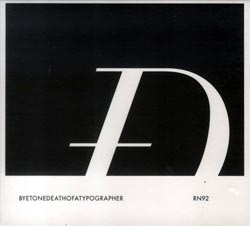
Death of a Typographer comes up with an intense reconfiguration of life support-like blips into a lumbering rhythmic beast. It expels energy through a succession of cloned metallic snare samples that act like a prosthesis working its way into and ultimately overtaking a thick network of cistern rumbles, pressure cooked noise, and unspecified electronic squawks.
In this stage, characterized by miniscule particles and their attraction to one another, forming algorithmically complex patterns, with tones fading into each other or folding back on themselves before being resuscitated by careful jolts, the focus is on the peculiar clarity of the individual segments. No one piece makes a definitive statement, but then neither do they venture elsewhere. Rather, Bender repeats variations upon the same basic formula and allows the differing results to accumulate. As this is happening, a circular process marked by breakneck appearance and rapid dis-investment, one is scarcely able to discern what is left in the compositions and what is left out — signs of certain techniques oftentimes appear in absence of the techniques themselves — and whether they are engaging in self or external reference.
Before reaching its end, however, this confusion from clarity is replaced by an impending emptiness, an attraction between the sound particles is usurped by an attraction to the void, and transcription gains favor over interpretation. Pieces periodically come to a juddering halt; sounds begin to hover more and stretch out over lengthy passages, with bass rumbles and high electronic notes gathering all at once and finally tapering away almost infinitesimally to nothingness. The transition is a significant one, but it is carried out with an ease that makes it appear almost non-existent, just as a snapshot suddenly isolates a neat slice of time and makes it seem unreal. The collected stills on display ultimately speak less to the Berlin winter in which they were made, and more to the dubious process through which it is eroded and reshaped in memory.
Comments and Feedback:

More Recent Reviews, Articles, and Interviews @ The Squid's Ear...
|





 Elliott Sharp:
 Olie Brice Quartet (Brice / Musson / Hawkins / Glaser):
 Joe Fonda:
 CHANGES TO blind:
 Eric La Casa / Marc Baron:
 Katie Porter:
 John Butcher / John Edwards:
 Webb Crawford / Michael Foster / Joey Sullivan:
 Lawrence Casserley / Emil Karlsen:
 Magda Mayas / Jim Denley: